
Detective Thomas Blake · Guide
How a Deduction Grid Works: From Witness Statements to a Closed File
The file on your desk
Every case starts the same way: a report, a handful of names, and statements that do not quite agree. Deduction puzzles for adults work on that premise. Everything you need is on the page, and your job is to put each fact where it belongs until one version of events is left standing.
In Detective Thomas Blake, that work happens on a deduction grid. This guide shows how the grid works, how to read the statements, how to catch a lying witness, and how the week comes together on Sunday.
One case, one week
Each week in the game is one case, split into files. Six files carry the labels Monday to Saturday, and each one opens when you solve the file before it. Once Thursday's file is closed, an optional Thursday bonus file opens beside it. Solve the bonus and you carry its key clue into Sunday. Skip it, and Sunday gives you a substitute clue that is less direct.
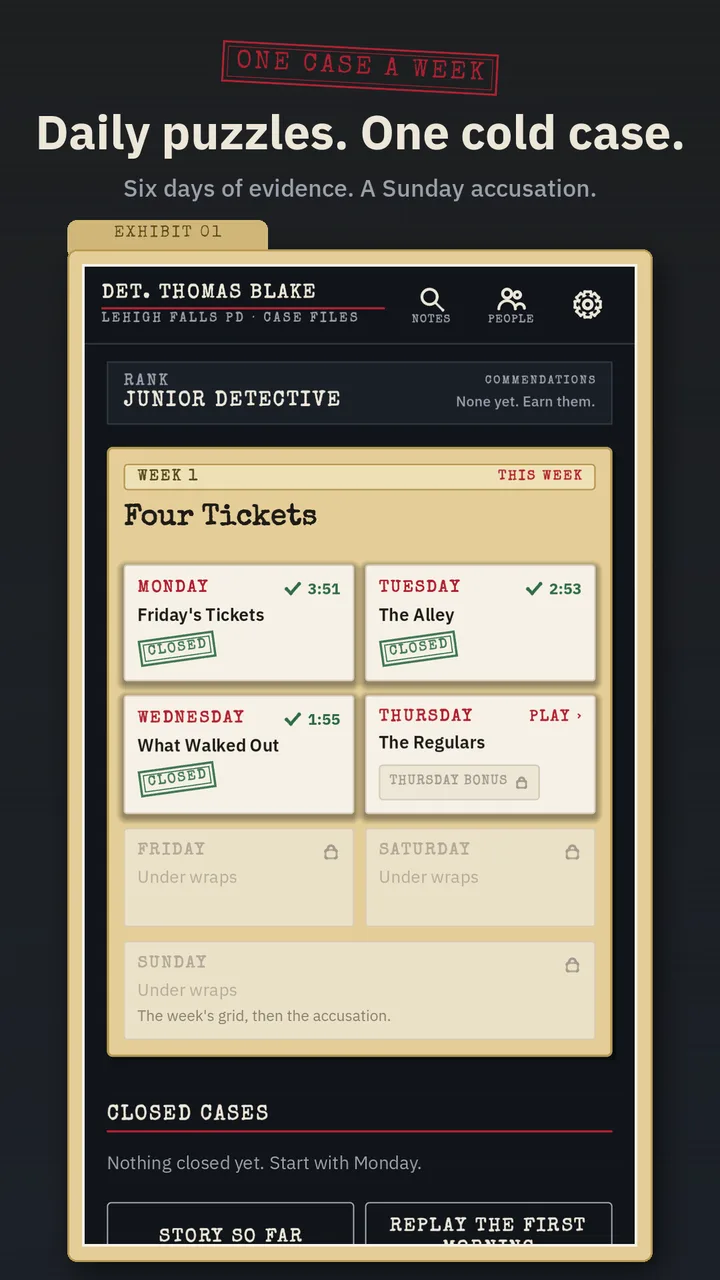
Sunday is the largest grid of the week. It pulls the case together, and then you make the accusation: suspect, motive and method. Get all three right and the week closes. A wrong call does not end the week; you try again.
What a deduction grid is
A deduction grid is a table of possibilities. Down the side are the people in the file; across the top, the other categories: what they brought, where they were, what time it was. Each person matches exactly one item in each category, and no two people share one.
Tap a cell once for a red cross (cannot be true), twice for a dot (true), a third time to clear it. With Auto-X on, a dot also crosses out the other open cells in its row and column of that block.
Every grid has exactly one solution, and the file gives you everything you need to reach it. If you are guessing, you have missed something in the file.
Worked example: Week 1, Monday
The first file of the first week is called "Friday's Tickets." A pawnshop on Seventh Street was pried open, and the drawer with Friday's pawn tickets went with it. Four customers came in Friday. Match each one to what they pawned and when.
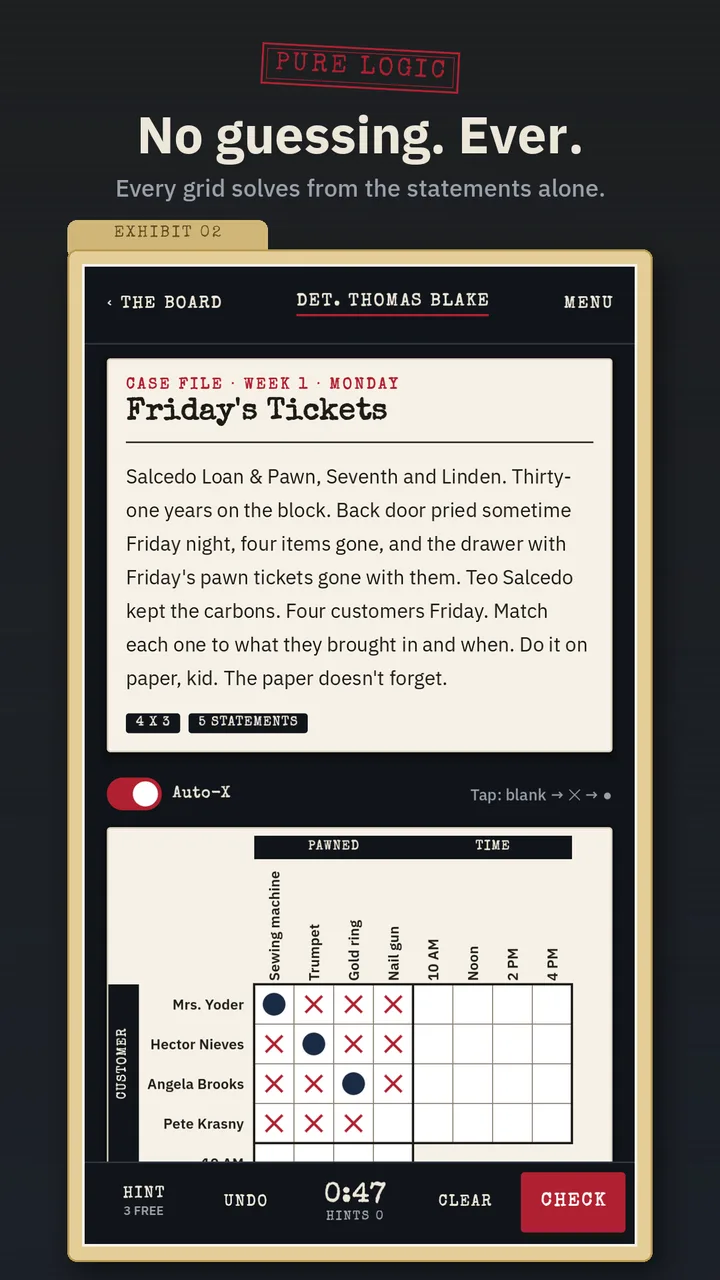
The people are Mrs. Yoder, Hector Nieves, Angela Brooks and Pete Krasny. The items are a sewing machine, a trumpet, a gold ring and a nail gun. The times are 10 AM, noon, 2 PM and 4 PM. The file gives five statements:
- The sewing machine came in before the ring did.
- The trumpet was ticketed exactly two hours after the ring.
- Pete Krasny was not the first customer of the day, and he didn't bring the trumpet.
- Angela Brooks brought the ring, and she was on her lunch break: noon.
- Hector Nieves came in the afternoon.
Step 1: Take what is handed to you
Statement 4 is a gift. Dot Brooks with the ring and Brooks with noon. Auto-X clears the rest of her row and those columns. Cross statement 4 off.
Step 2: Chain the times
The ring came in at noon. Statement 2 puts the trumpet two hours later, at 2 PM. Statement 1 puts the sewing machine before noon, and the only earlier time is 10 AM. That leaves the nail gun at 4 PM. You have not placed a single other person yet, but every item now has a time.
Step 3: Eliminate
Statement 3 says Krasny was not first, so he was not at 10 AM. He did not bring the trumpet, so he was not at 2 PM. Noon belongs to Brooks. Krasny came in at 4 PM, with the nail gun.
Step 4: Close it
Statement 5 puts Nieves in the afternoon. 4 PM is taken, so Nieves came in at 2 PM with the trumpet. Mrs. Yoder is the only customer left, at 10 AM with the sewing machine.
| Customer | Pawned | Time |
|---|---|---|
| Mrs. Yoder | Sewing machine | 10 AM |
| Angela Brooks | Gold ring | Noon |
| Hector Nieves | Trumpet | 2 PM |
| Pete Krasny | Nail gun | 4 PM |
Notice the order: you started with the hardest fact and followed the numbers. Times, amounts and dates are the spine of most files, because one fixed point pins down everything around it.
When a witness is lying
Later files add a second list under the statements: Witnesses. Statements are always true; witness accounts are not. In any file with witnesses, exactly one is lying, and the file is not solved until you tap "Lying" on that one.
Here is a small original example in the same format. It is not from the game.
Three people, three places: a diner, a bus depot and a laundromat. One statement: Cruz was not at the diner. Three witnesses:
- Night clerk: "Abel was at the laundromat."
- Bus driver: "Burke was at the bus depot."
- Waitress: "Cruz was at the bus depot."
The driver and the waitress cannot both be right, because two people cannot share the depot. So one of them is the liar, and the clerk is telling the truth: Abel was at the laundromat. That leaves the diner and the depot for Burke and Cruz. The statement says Cruz was not at the diner, so Cruz was at the depot and Burke was at the diner. The waitress holds up. The driver does not.
| Person | Diner | Bus depot | Laundromat |
|---|---|---|---|
| Abel | ✕ | ✕ | ● |
| Burke | ● | ✕ | ✕ |
| Cruz | ✕ | ● | ✕ |
The lesson carries to every file: look for two witnesses who cannot both be telling the truth. The liar is one of them, and everyone else is now on solid ground.
Sunday: the grid that holds the week
Sunday's grid is four categories by five. Thursday's key clue, or its substitute, is added as the last statement, and like every statement it is true. Work it the same way: fixed points, then numbers, then the witness who does not fit. When the grid holds, the accusation opens: who, why and how. Close the week and the next case opens. From Week 4, a closed week also opens After Hours, where you quietly reopen the Jefferson file.
Habits that close files
- Start with the statement that names two things outright.
- Follow any statement with a number in it before the vague ones.
- Tap a statement to cross it off once it is used, and pin the one you keep coming back to.
- Stuck? You get three hints a day. A hint flashes the block where something does not add up, or reveals one cell.
Your shift starts Monday. Open the first file in Detective Thomas Blake and see what everyone missed.


More about Detective Thomas Blake.