
Mantiki: Logic Puzzles · Guide
How to Solve Logic Puzzles Without Guessing
Every puzzle in Mantiki has exactly one solution, and logic alone always reaches it. That changes how you play. If you ever feel the need to guess, it means there is a deduction you have not spotted yet. This guide walks through the reasoning Mantiki's Academy teaches in its 38 lessons, from first moves to the X-Wing and "what if" reasoning. The examples use Mantiki's six kinds of puzzle: Sun & Moon, Campsite, Bridges, Crowns, Picture Grid and Number Box.
The one habit behind every technique
Before you place anything, ask: "What must be true here?" Not what might fit, but what the rules force. Start with the simplest checks and reach for heavier tools only when those run dry.
Start with single-step deductions
Rule of thumb: look for a cell that one rule settles all by itself.
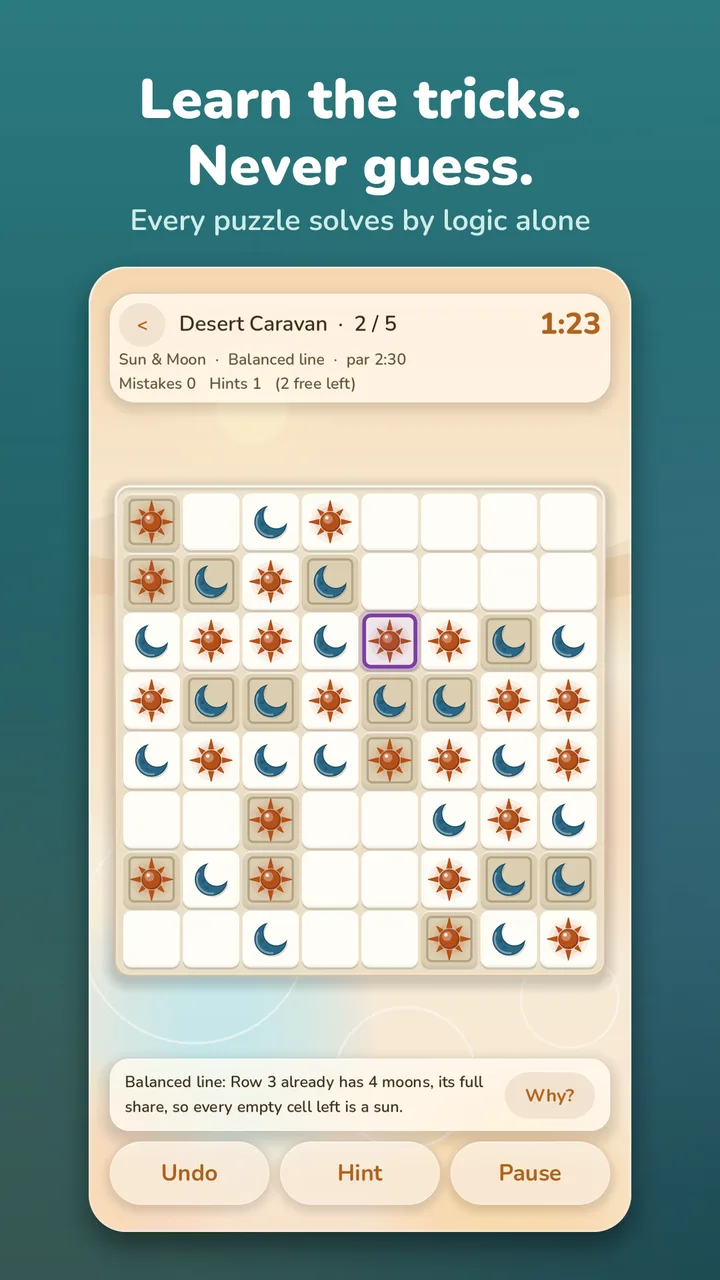
Sun & Moon shows this well. It is a binary puzzle: every cell holds a sun or a moon, never three alike in a row or column, and every line holds the same number of each. The Academy's first lesson teaches two quick moves:
- Break the pair: two suns side by side need a moon on each end.
- Fill the gap: a single empty cell between two suns must be a moon.
The same two moves work for moons. Then add Balanced line: once a line has its full share of one symbol, every empty cell left is the other.
Here is a row of six cells (S is a sun, M is a moon, a dot is empty):
| 1 | 2 | 3 | 4 | 5 | 6 |
|---|---|---|---|---|---|
| S | S | . | M | S | . |
Cells 1 and 2 are a pair of suns, so cell 3 must be a moon. Now the row has three suns, its full share in a line of six, so cell 6 is a moon too. The row reads S S M M S M, and you never had to guess.
Every kind of puzzle has its own version of this. In Crowns, One spot left says that when a row, column or region has only one open cell, its crown goes there. In Bridges, a Finished island already has all its bridges, so no more can be added to it.
Count what a line still needs
Rule of thumb: compare what a line needs with the room it has left.
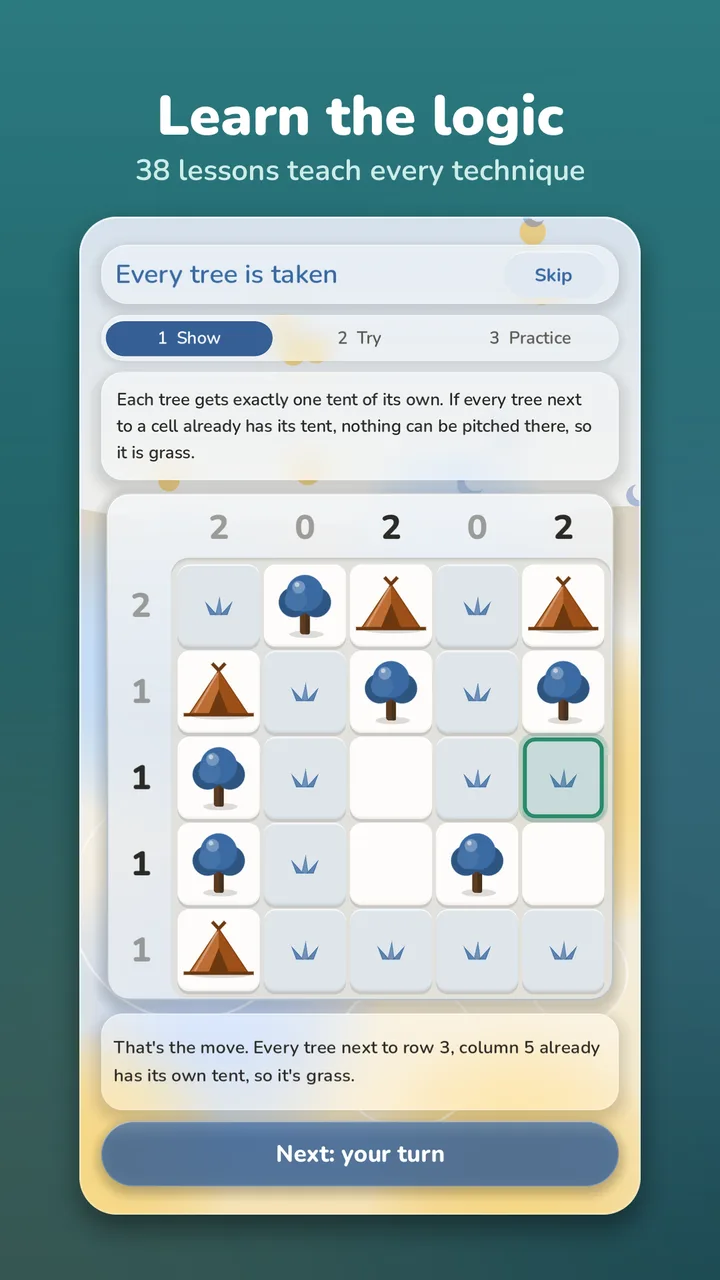
Campsite asks you to place a tent beside every tree, with tents never touching, not even at the corners, and numbers telling how many tents each row and column holds. Its Full row technique says that a line with all its tents has only grass left. Just enough room is the mirror image: if a row needs two more tents and has exactly two open cells, both are tents.
Picture Grid uses counting in a sharper way, called Simple overlap. Take a row of ten cells with the clue 7. Push the run of seven as far left as it can go and it covers cells 1 to 7. Push it right and it covers cells 4 to 10.
| Position | 1 | 2 | 3 | 4 | 5 | 6 | 7 | 8 | 9 | 10 |
|---|---|---|---|---|---|---|---|---|---|---|
| Pushed left | # | # | # | # | # | # | # | . | . | . |
| Pushed right | . | . | . | # | # | # | # | # | # | # |
Cells 4 to 7 are shaded in both positions, so they must be shaded, wherever the run really sits.
Try every way a line can fit
Rule of thumb: when a line is nearly full, list every legal way to finish it. A cell that comes out the same in all of them is settled.
Mantiki teaches this in several kinds of puzzle: Only one way fits in Sun & Moon, Count the line in Campsite, and Line logic: always shaded and Line logic: never shaded in Picture Grid.
Look at groups, not single cells
Rule of thumb: when two or more cells or regions share the same limits, treat them as a team.
In Crowns, which is a star battle-style region puzzle (one crown per row, column and color region, never touching), Squeezed region notices when all of a region's open cells sit in one row. That region's crown will land in that row, so every other cell in the row can be ruled out. Pigeonhole stretches the idea: if two regions fit only inside the same two columns, their two crowns fill those columns, and every other cell there is out.
Number Box has the same kind of teamwork. Each row, column and outlined box holds every number exactly once. A Naked pair is two cells in a group that can only be the same two numbers, say 1 and 6. Those numbers belong to those two cells, so you can cross 1 and 6 off the rest of the group. Pointing and Claiming do the same between a box and a line.
The X-Wing technique, explained
Rule of thumb: when a number fits in exactly the same two columns in two different rows, cross it off the rest of those two columns.
Here is a made-up example. The table shows only where the number 1 can still go in a six-by-six Number Box, whose boxes are three cells wide and two tall. A dash means a 1 cannot go there.
| C1 | C2 | C3 | C4 | C5 | C6 | |
|---|---|---|---|---|---|---|
| R1 | 1 | 1 | - | - | - | - |
| R2 | - | - | - | 1 | 1 | - |
| R3 | 1 | - | 1 | 1 | - | - |
| R4 | - | 1 | - | - | - | 1 |
| R5 | - | - | 1 | - | 1 | 1 |
| R6 | - | 1 | - | - | - | 1 |
Nothing simpler works here: every row, column and box still has at least two spots for its 1. But look at rows 4 and 6. In both, the 1 can only go in columns 2 and 6. There are just two ways that can play out: row 4 takes column 2 and row 6 takes column 6, or the other way around. Either way, columns 2 and 6 get their 1 from rows 4 and 6. So the 1 in row 1, column 2 and the 1 in row 5, column 6 can be crossed off. That leaves row 1 with one spot for its 1 (column 1), and the board starts to open up.
The four bold cells form a rectangle. It works the same with rows and columns swapped. Mantiki's later Number Box lessons build on it: Swordfish is a bigger X-Wing across three rows and three columns, and Y-Wing, XYZ-Wing and Coloring follow chains of cells that each have only two or three choices.
"What if" reasoning: follow it to a contradiction
Rule of thumb: when nothing simple works, imagine one choice and follow the rules. If you reach something impossible, the cell must be the other way.
This is not guessing. You never commit to the imagined choice; you only use it to prove something. Mantiki has a "What if" lesson for Sun & Moon, Campsite, Bridges, Crowns and Picture Grid.
Take this Sun & Moon row of six:
| 1 | 2 | 3 | 4 | 5 | 6 |
|---|---|---|---|---|---|
| S | . | M | . | . | S |
What if cell 2 were a sun? Then the row would have three suns (cells 1, 2 and 6), its full share, so cells 4 and 5 would both be moons. With cell 3, that makes three moons in a row, which breaks the rules. So cell 2 must be a moon. Now cells 2 and 3 are a pair of moons, so cell 4 is a sun. That makes three suns, so cell 5 is a moon. The row is S M M S M S.
Practice with hints that explain why
When you are stuck in Mantiki, a hint shows the next logical step, names the technique and explains it in a line. Tap "Why?" for a card with the technique's lesson, and open the full lesson from there if you want more. Each Academy lesson has three steps: Show, where you watch the technique; Try, where you do it yourself; and Practice, on a real puzzle. Then the 12 themed worlds give you boards to use them on.
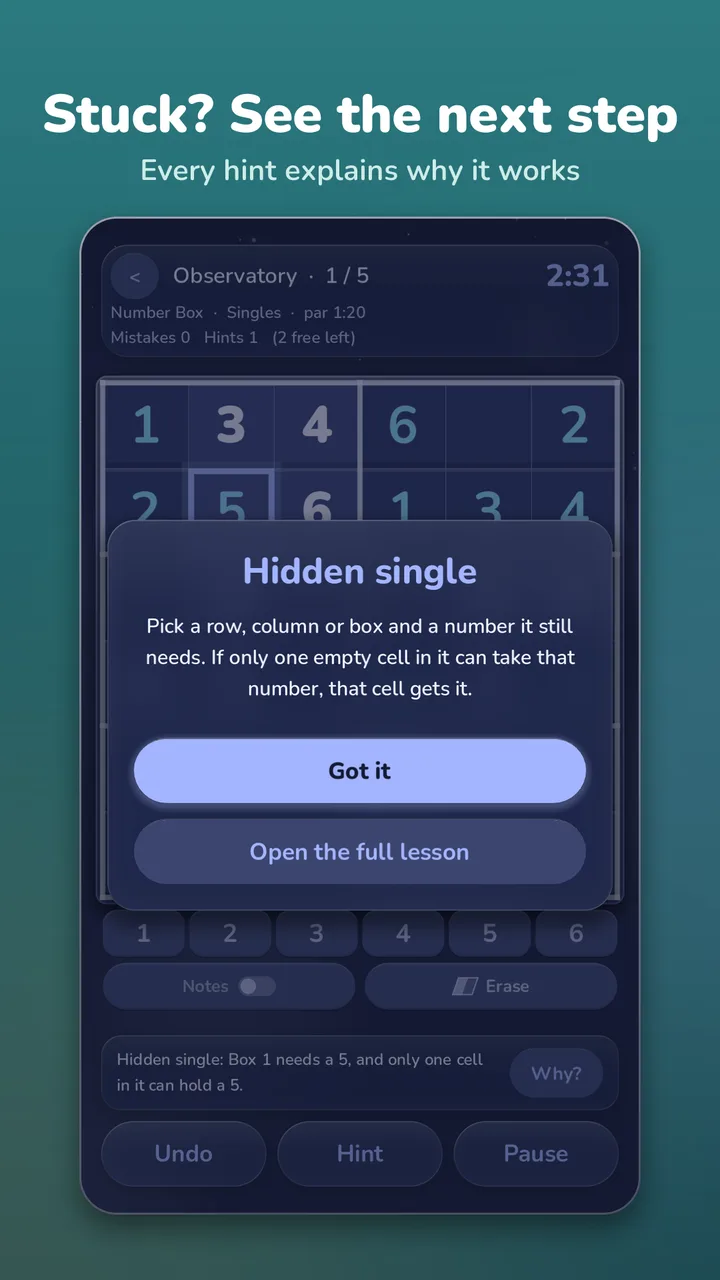
Learn the tricks. Never guess. Try these techniques yourself in Mantiki, where every hint tells you why.


More about Mantiki: Logic Puzzles.