
Mantiki: Logic Puzzles · Guide
Crowns Puzzle: Rules and Tips
Crowns is Mantiki's star battle-style region puzzle: you place crowns on a board split into color regions, one per row, column and region. This guide covers the crown puzzle rules exactly as Mantiki plays them, the techniques its Academy teaches, and a small board solved one move at a time. For the habits behind all of Mantiki's puzzles, see How to Solve Logic Puzzles Without Guessing.
Crown puzzle rules in Mantiki
A Crowns board is a square grid divided into as many color regions as it has rows. Place crowns so that:
- Every row holds exactly one crown.
- Every column holds exactly one crown.
- Every color region holds exactly one crown.
- No two crowns touch, not even diagonally. The eight cells around a crown stay empty.
That is the whole rule set, on every size: never two crowns per line. Every board has exactly one solution and is checked for it before you see it.
How to play Crowns in Mantiki
Crowns starts with an empty board; the regions are the only clues. Tap a cell once to mark it with an X (no crown here), twice to place a crown, and a third time to clear it. Drag across cells to X several at once. X marks are only notes for you: the board counts as solved once every crown is in place.
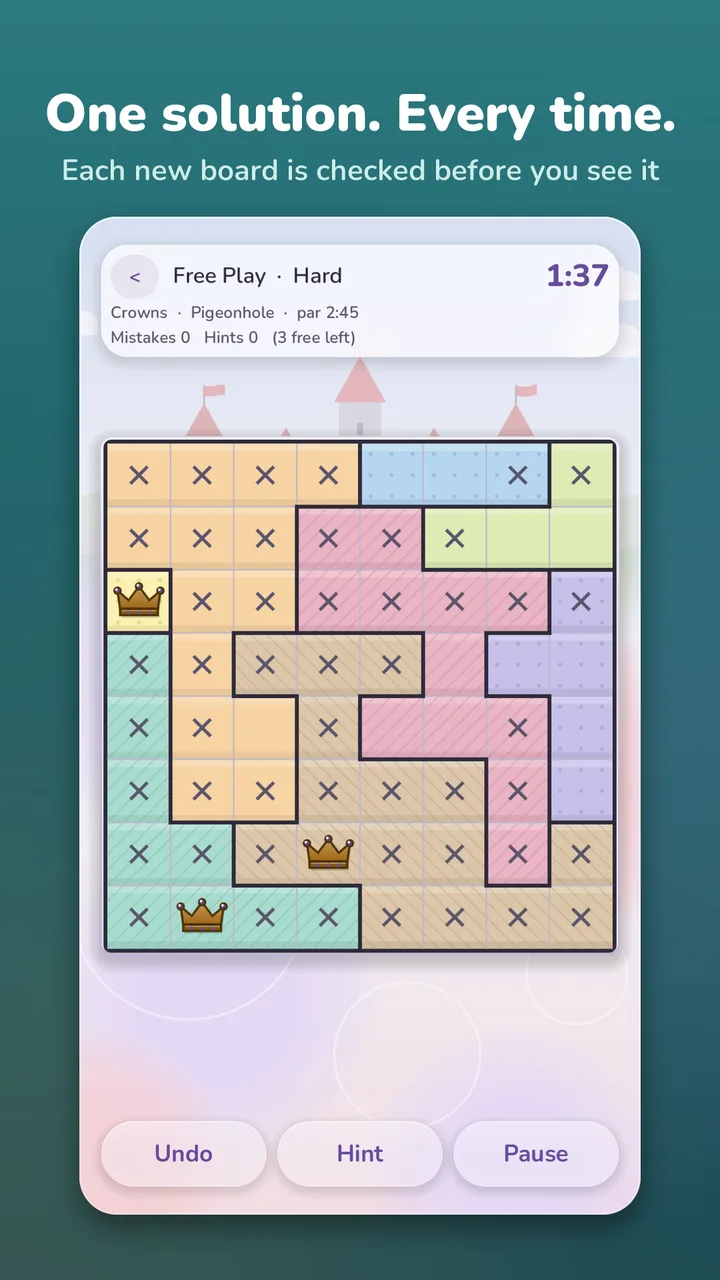
If two crowns share a row, column or region, or touch each other, Mantiki marks them. It also marks a row, column or region you have filled with X's and left no room for a crown. It never flags a move that is legal but wrong.
The Academy teaches on 5x5 boards. The Journey runs from 6x6 up to 10x10. When you pick a level yourself, Easy is 7x7, Medium and Hard are 8x8, and Expert is 9x9; if a board takes too long to make, you may get one size smaller at the same difficulty.
The techniques the Academy teaches
Mantiki's Academy has six Crowns lessons, each with a Show, Try and Practice step.
- A crown clears its area and One spot left come first, in Crowns Basics. A placed crown rules out the rest of its row, column and region, plus the eight cells around it. And when a row, column or region has only one open cell, the crown goes there.
- Squeezed region. If every open cell of a region sits in one row, that region's crown will use that row, so X every other cell in it. The same works for columns.
- Row owned by a region is the mirror image. If every open cell of a row belongs to one region, that region's crown is in that row, so X the region's cells everywhere else.
- Would leave no room. Imagine a crown in a cell. If it would cross out every open cell of some other row, column or region, the cell is an X.
- Pigeonhole. If two regions fit inside the same two rows, their two crowns use up both rows, so every other cell in those rows is an X. It also works with more regions, and with columns.
- What if is the last lesson: pretend a cell holds a crown, follow the simpler rules, and if some row, column or region ends up with no room, the cell is an X.
A worked 6x6 board
This board has six regions, A to F, and exactly one solution. Rows are R1 to R6, columns C1 to C6.
| C1 | C2 | C3 | C4 | C5 | C6 | |
|---|---|---|---|---|---|---|
| R1 | A | A | A | B | B | C |
| R2 | A | A | B | B | B | C |
| R3 | A | D | B | B | B | C |
| R4 | E | E | B | B | C | C |
| R5 | E | E | E | E | E | F |
| R6 | E | E | E | E | E | F |
Work through it one move at a time:
- One spot left, region D: it is a single cell, so R3C2 holds a crown.
- A crown clears its area: X the rest of row 3 and column 2, and every cell around R3C2.
- Squeezed region, region A: its only open cells left are R1C1 and R1C3, both in row 1. X the rest of row 1: R1C4, R1C5 and R1C6.
- Squeezed region, region F: both its cells are in column 6, so X R2C6 and R4C6.
- One spot left, region C: only R4C5 is still open. Place a crown there and clear its area, which takes R2C5 out.
- One spot left, row 2: C1, C2 and C3 touch the first crown, and C5 and C6 are gone, so R2C4 holds a crown. Clearing its area removes R1C3.
- Row 1 now has one open cell, R1C1. Crown it and clear column 1.
- Row 5 has one open cell left, R5C3. Crown it, and the last crown lands at R6C6.
The finished board:
| C1 | C2 | C3 | C4 | C5 | C6 | |
|---|---|---|---|---|---|---|
| R1 | Crown | x | x | x | x | x |
| R2 | x | x | x | Crown | x | x |
| R3 | x | Crown | x | x | x | x |
| R4 | x | x | x | x | Crown | x |
| R5 | x | x | Crown | x | x | x |
| R6 | x | x | x | x | x | Crown |
One crown per row, column and region, and none touch, even at the corners.
Tips for steady solving
- Start with the smallest regions. A one-cell region is an instant crown, and a two-cell region often sits in one row or column.
- Clear the area every time. Mark a crown's row, column, region and neighbors before looking for the next move.
- Count regions against rows when you stall. Two regions boxed into two rows is a Pigeonhole waiting to be used.
- Use a hint to learn, not just to move. Mantiki's hints name the technique and explain the step.
Ready to try it? Open Crowns in Mantiki and start with the Academy's Crowns Basics lesson.


More about Mantiki: Logic Puzzles.