
Mantiki: Logic Puzzles · Guide
Sun & Moon Puzzle: Rules and Tips
Sun & Moon is a binary puzzle: every cell on the board holds one of two symbols, a sun or a moon. This guide shows how to play a binary puzzle exactly as Mantiki plays it: the rules, the first techniques its Academy teaches, and a small board solved step by step. For the general habits behind all of Mantiki's puzzles, see How to Solve Logic Puzzles Without Guessing.
Binary puzzle rules in Sun & Moon
Fill every cell with a sun or a moon, following two rules:
- Never three alike in a row or column. Two suns side by side are fine; three are not. The same goes for moons.
- Every row and column holds the same number of each. A line of six cells holds three suns and three moons. A line of eight holds four of each, and a line of ten holds five.
Mantiki does not add a rule that every row or column must be different from the others. Two rows can match, and in the worked board below, they do.
Every board has exactly one solution, and each one is checked for it before it reaches your screen.
How to play Sun & Moon in Mantiki
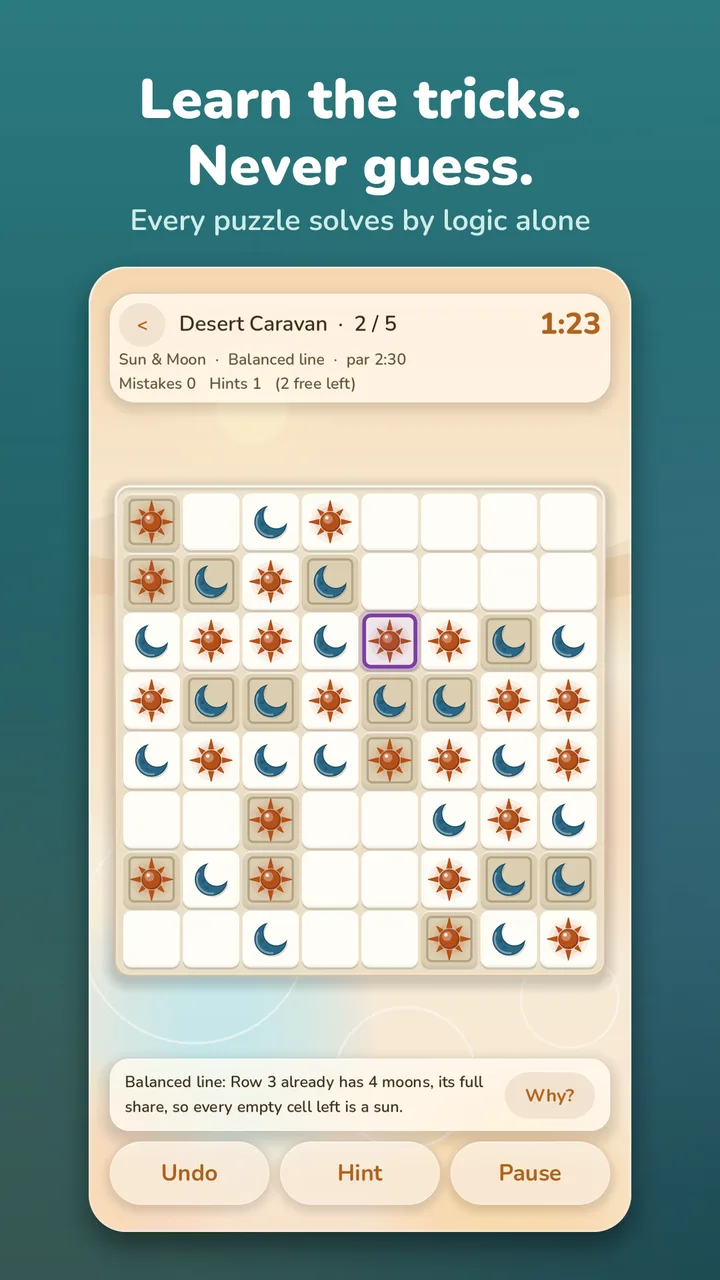
Tap an empty cell once for a sun, twice for a moon, and a third time to clear it. The symbols printed at the start, called givens, sit on darker tiles and cannot be changed.
If a move breaks a rule, such as three moons in a row or a fourth sun in a line of six, Mantiki marks the cells involved. It does not flag a move that is legal but wrong, so the logic stays yours.
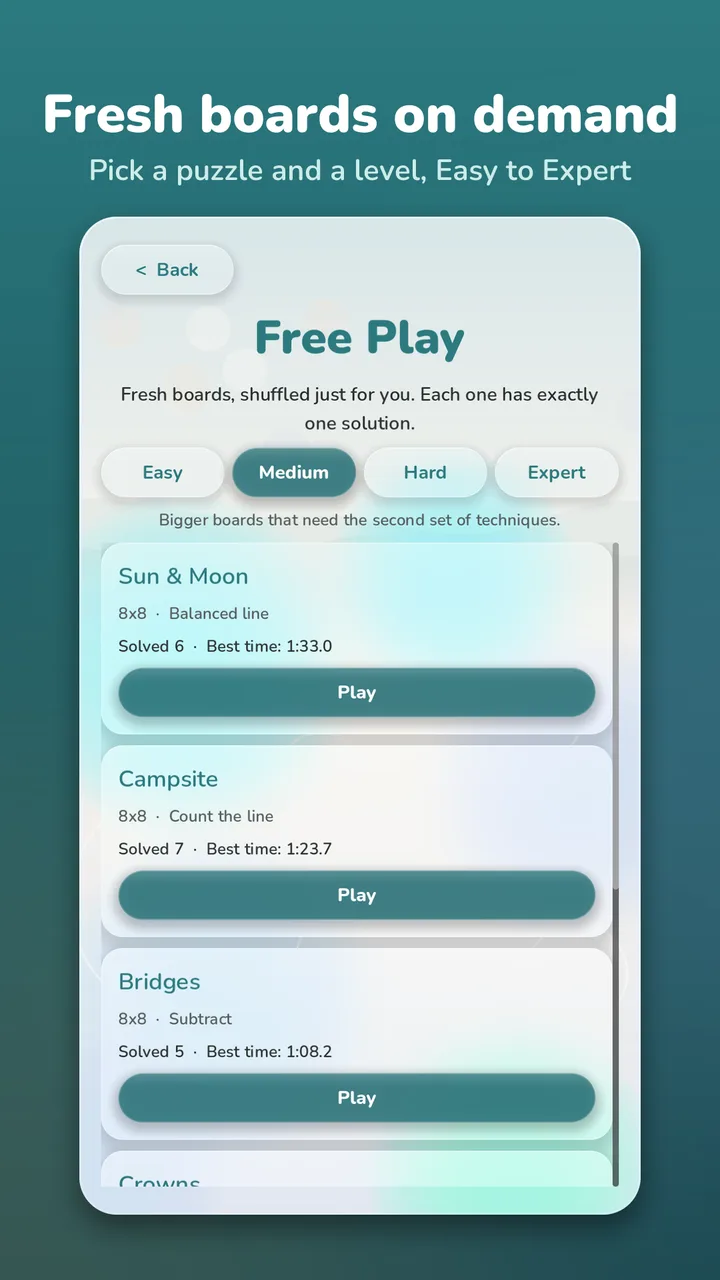
Boards come in three sizes: 6x6, 8x8 and 10x10. When you pick a level yourself, Easy is 6x6, Medium and Hard are 8x8, and Expert is 10x10.
The techniques the Academy teaches first
Mantiki's Academy has four Sun & Moon lessons, each with a Show, Try and Practice step.
- Break the pair and Fill the gap come first, in the Sun & Moon Basics lesson. Two suns side by side need a moon on each end. A single empty cell between two suns must be a moon. Both work the same way for moons.
- Balanced line comes next. Once a line has its full share of one symbol, every empty cell left is the other.
- Only one way fits is for lines those moves cannot settle. Picture every legal way to finish the line. If a cell comes out the same in all of them, it must be that symbol.
- What if is the last lesson: imagine a cell is a sun, follow the rules, and if something breaks, the cell is a moon.
Here is Only one way fits in a row of six (S is a sun, M is a moon, a dot is empty):
| 1 | 2 | 3 | 4 | 5 | 6 |
|---|---|---|---|---|---|
| S | . | . | . | . | S |
The row needs one more sun somewhere in cells 2 to 5. Put it in cell 2 and cells 3, 4 and 5 are three moons in a row. Put it in cell 5 and the same thing happens. So the last sun goes in cell 3 or 4, and in both cases cells 2 and 5 are moons.
A worked 6x6 board
This board has seven givens and exactly one solution. Rows are R1 to R6, columns C1 to C6.
| C1 | C2 | C3 | C4 | C5 | C6 | |
|---|---|---|---|---|---|---|
| R1 | . | . | . | . | . | . |
| R2 | . | . | S | . | . | . |
| R3 | . | M | . | M | . | . |
| R4 | . | M | . | . | . | . |
| R5 | . | . | . | . | M | . |
| R6 | S | S | . | . | . | . |
Work through it one move at a time:
- Fill the gap, row 3: the empty cell between two moons, R3C3, is a sun.
- Break the pair, row 6: the suns in C1 and C2 need a moon at R6C3.
- Break the pair, column 2: the moons in R3 and R4 need a sun on each end, at R2C2 and R5C2.
- Row 2 now has a pair of suns in C2 and C3, so R2C1 and R2C4 are moons.
- Column 3 has a pair of suns in R2 and R3, so R1C3 and R4C3 are moons.
- Row 4 has a pair of moons in C2 and C3, so R4C1 and R4C4 are suns.
- Fill the gap, column 1: R5C1 sits between suns in R4 and R6, so it is a moon.
- Balanced line, column 2: it now holds three suns, its full share, so R1C2 is a moon.
The board now looks like this:
| C1 | C2 | C3 | C4 | C5 | C6 | |
|---|---|---|---|---|---|---|
| R1 | . | M | M | . | . | . |
| R2 | M | S | S | M | . | . |
| R3 | . | M | S | M | . | . |
| R4 | S | M | M | S | . | . |
| R5 | M | S | . | . | M | . |
| R6 | S | S | M | . | . | . |
Try the rest yourself. Row 1 has a fresh pair of moons to break. The same three moves finish the board, and here is the solution to check against:
| C1 | C2 | C3 | C4 | C5 | C6 | |
|---|---|---|---|---|---|---|
| R1 | S | M | M | S | S | M |
| R2 | M | S | S | M | M | S |
| R3 | M | M | S | M | S | S |
| R4 | S | M | M | S | S | M |
| R5 | M | S | S | M | M | S |
| R6 | S | S | M | S | M | M |
Rows 1 and 4 match, and so do rows 2 and 5. In Mantiki that is allowed.
Binary puzzle tips for steady solving
- Scan for pairs and gaps first. They are the cheapest moves, and each one you place often creates the next.
- Keep a running count. In a line of six, the moment you see three of one symbol, the rest are settled.
- Switch direction often. A move in a row often opens one in a column.
- List the ways when a line is nearly full. Only one way fits is easiest with two or three empty cells left.
- Use a hint to learn, not just to move. Mantiki's hints name the technique and explain the step.
Ready to put these rules to work? Try Sun & Moon in Mantiki, starting with the Academy's Basics lesson.


More about Mantiki: Logic Puzzles.