
Mantiki: Logic Puzzles · Guide
Campsite Puzzle: Rules and Tips
Campsite is Mantiki's logic puzzle about pitching tents: trees stand on a grid, and you pitch one tent beside each of them, with the numbers around the edge as your only guide. Here are the rules as Mantiki plays them, the six techniques its Academy teaches, and a small board solved step by step. For habits that work in every Mantiki puzzle, see How to Solve Logic Puzzles Without Guessing.
The rules of Campsite
Place tents so that all three rules hold:
- Every tree gets its own tent right beside it. Beside means up, down, left or right, never diagonal. Each tent belongs to one tree, so seven trees mean seven tents.
- Tents never touch, not even diagonally. None of the eight cells around a tent holds another tent.
- The numbers count the tents. The number left of a row, or above a column, says how many tents that line holds. A zero means none.
A tent may stand beside two trees if every tree still gets its own.
Every board has exactly one solution, and each one is checked for it before it reaches your screen.
How to play Campsite in Mantiki
Tap an empty cell once for grass, twice for a tent, and a third time to clear it, or drag across empty cells to mark grass. Trees and starting cells are locked.
Grass marks are notes for you. The puzzle is solved when your tents match the solution; unmarked cells count as grass.
A line's number dims when it has all its tents and sits on an error marker when it has too many. Mantiki also marks touching tents, a tent with no tree beside it, and a tree surrounded by grass. It does not flag a move that is legal but wrong, so the logic stays yours.
Academy lessons use 5x5 boards. When you pick a level yourself, Easy is 7x7, Medium is 8x8, and Hard and Expert are 10x10.
The techniques the Academy teaches
Mantiki's Academy has six Campsite lessons, each with a Show, Try and Practice step.
- Campsite Basics teaches five moves. No tree, no tent: a cell with no tree beside it is grass. Tents need space: the eight cells around a tent are grass. Full row: a line with all its tents is grass everywhere else. Just enough room: a line that needs as many tents as it has open cells is all tents. Only one spot: a tree with no tent and one open neighbor gets its tent there.
- Count the line: try every way to fit a line's missing tents, no two side by side. A cell that is a tent in every way is a tent; a cell never used is grass.
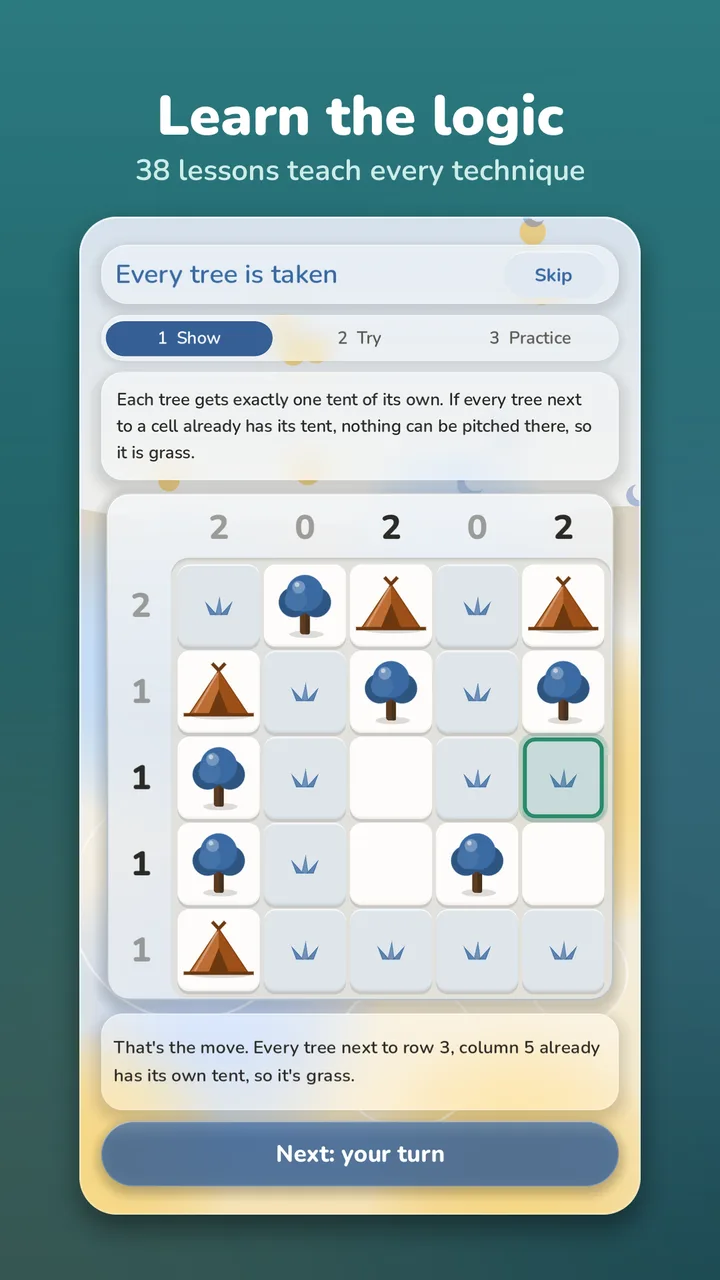
- Every tree is taken: if every tree beside a cell already has its tent, the cell is grass.
- Last spot for a tree: if only one open cell is left beside a tree that still needs a tent, the tent goes there.
- In the way: a cell that would touch a tree's tent wherever it goes is grass.
- What if: imagine a cell is a tent and follow the rules. If something breaks, it is grass. It works the other way around too.
Here is Count the line in a row of six that needs two tents (T is a tree, g is grass, a dot is open):
| 1 | 2 | 3 | 4 | 5 | 6 |
|---|---|---|---|---|---|
| g | . | . | . | T | g |
Two tents in cells 2 to 4 with none side by side fit only one way: cells 2 and 4 are tents, and cell 3 is grass.
A worked 6x6 board
This board has seven trees and exactly one solution. Tent counts are in parentheses.
| C1 (1) | C2 (2) | C3 (1) | C4 (0) | C5 (1) | C6 (2) | |
|---|---|---|---|---|---|---|
| R1 (2) | T | . | . | . | . | . |
| R2 (0) | . | . | . | . | . | T |
| R3 (2) | . | . | T | . | T | . |
| R4 (0) | . | . | . | . | T | . |
| R5 (2) | . | T | . | . | . | . |
| R6 (1) | . | . | . | T | . | . |
Solve it one move at a time:
- Full row for the zeros: row 2, row 4 and column 4 are grass.
- No tree, no tent: R1C3, R1C5, R3C1, R5C6, R6C1 and R6C6 touch no tree, so they are grass.
- Just enough room, row 1: it needs two tents, and only R1C2 and R1C6 are open. Both are tents.
- Just enough room, row 3: the same holds for R3C2 and R3C6.
- Full row, column 2: it has its two tents, so R6C2 is grass.
- Just enough room, column 1: R5C1 is its only open cell, so it is a tent.
- Only one spot: the tree at R4C5 has one open neighbor, R5C5. That is its tent.
- Tents need space: the cells around R5C5 are grass, including R6C5.
- Full row, row 5: it has both tents, so R5C3 is grass.
- Just enough room, row 6: R6C3 is its last open cell, so it is a tent.
Here is the solution (A is a tent, g is grass):
| C1 | C2 | C3 | C4 | C5 | C6 | |
|---|---|---|---|---|---|---|
| R1 | T | A | g | g | g | A |
| R2 | g | g | g | g | g | T |
| R3 | g | A | T | g | T | A |
| R4 | g | g | g | g | T | g |
| R5 | A | T | g | g | A | g |
| R6 | g | g | A | T | g | g |
Tips for solving Campsite puzzles
- Start with zeros and empty ground. They turn to grass at once.
- Mark grass as you go. It is optional, but it makes the open cells easy to count.
- Pair tents with trees. When a tree's neighbors are claimed, Last spot for a tree and Every tree is taken follow.
- Use a hint to learn, not just to move. Mantiki's hints name the technique and explain the step.
For a two-symbol grid taught the same way, see the Sun & Moon guide. Ready to pitch your first tent? Try Campsite in Mantiki, starting with the Academy's Campsite Basics lesson.


More about Mantiki: Logic Puzzles.